At Least We're Drinking Water: the Rise of Liquid Death
The reason you're watching the ad isn't for Martha Stewart, exactly. The reason you're watching is that Martha Stewart is chopping up grown men like vegetables.

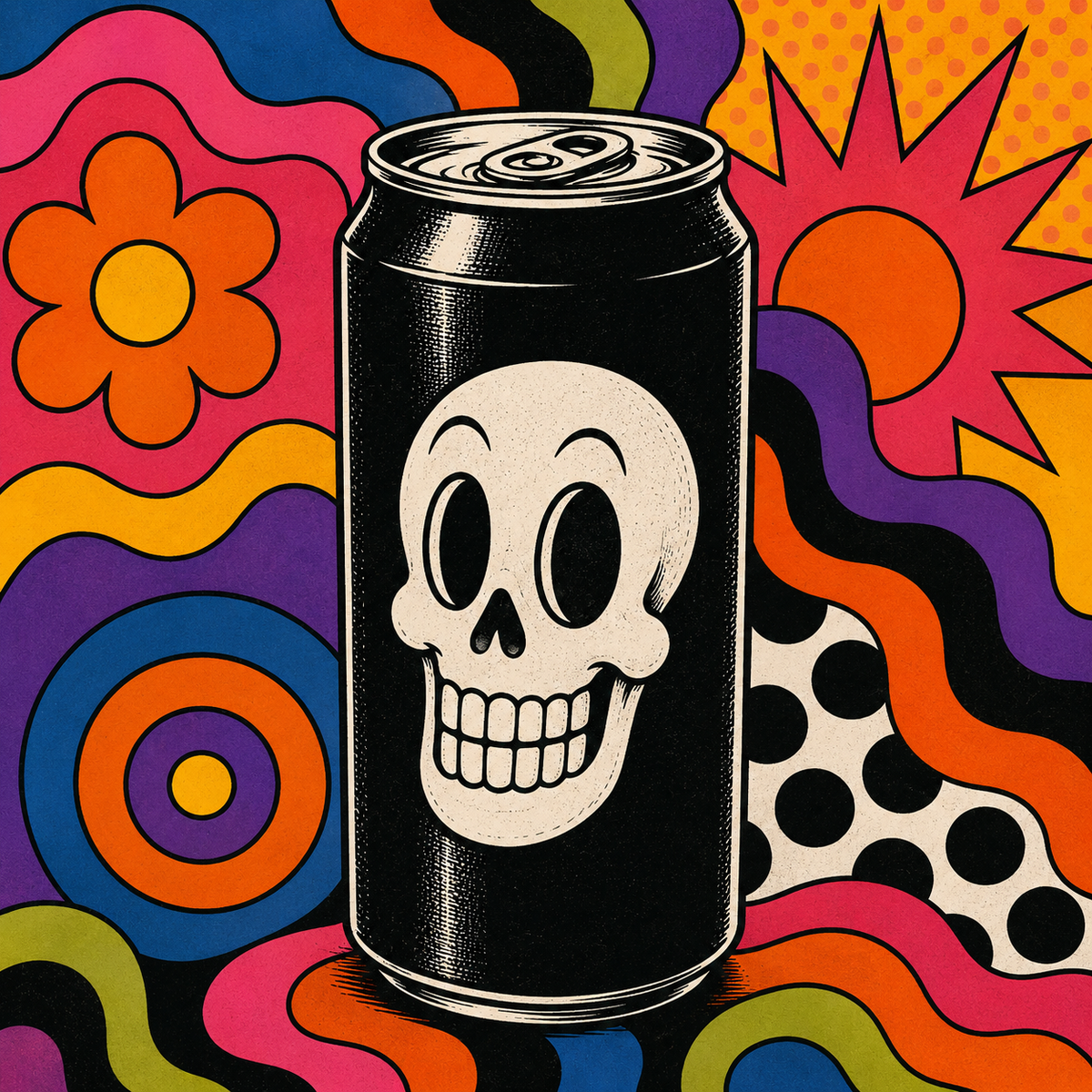
Back in 2024, I had a job interview that led to me holing up at an eerily silent and crumbling Best Western in northern Wisconsin. While the amenities were close to zero, the motel did offer a pool and a hot tub and I figured that beat the hell out of bad TV in the room. I ventured out for supplies and found the only show in town: a Walmart. There, I picked up a bottle of Irish whiskey. Then the Functioning Adult part of my brain kicked in and I went to look for water. In an endless valley of hydration choices, my eyes immediately went to the tallboy cans of Liquid Death, a company I was vaguely aware of. The four-packs were on sale and I figured it was the right amount of água de beber to get me through to the next morning, when I would head back to Milwaukee.
More than two and a half years later, the company's silly branding has managed to leave its mark on my psyche. Their madcap marketing is working exactly as designed.
The origins of the company trace back to the Vans Warped Tour, where its founder, CEO Mike Cessario, noticed bands drinking water out of Monster cans to look the part for their sponsor. Energy drinks had spent decades buying their way into punk, metal, and skate culture; Cessario set out to take that entertainment-first playbook and point it at a product people could actually feel good about drinking. Thus, Liquid Death was born. Cessario’s decade of experience in the advertising business clearly inspires his company's brand strategy: viral and eye-popping collaborations, peppered with wacky stunts. Teaming up with other companies allows Liquid Death to cut down on its production costs while creating something that cannot be ignored. This includes Martha Stewart's Dismembered Moments promotion, which features Stewart cutting off the hands of blindfolded fans clutching cans of Liquid Death, supposedly turned into wax candles (at $58 a pop), with audible screams and buckets of blood. Other examples, per Fast Company: limited-edition e.l.f. Cosmetics Corpse Paint that sold out in 45 minutes (think Gene Simmons of KISS), Tony Hawk's Blood Skateboards, painted with the celebrity's actual blood, and a Depends partnership to launch the $75 "Pit Diaper," a pleather garment meant to help hardcore rockers avoid crappy rock show bathrooms (pun definitely intended).
While some have questioned how a punk-rock coded can of water could possibly compete against Coke, Pepsi, and others, Cessario indicates this misses the point, telling Fast Company the company's objectives this way: "Water is a category driven mostly by brand. So we build brand first, and we represent a point of view." The Vice President of Creative, Andy Pearson, summarized the same idea to Marketing Dive by framing modern currency: "You pay for stuff, not just with money, but with time, likes, following and all of that." Liquid Death focuses on awareness and reach through moments far too crazy to ignore, such as placing a $50,000 bet on the underdog Cincinnati Bengals and sending a witch into the stadium to hex the favored LA Rams. The Rams still pulled off the win, but so too did Liquid Death, as it got the media buzzing. The stunt was a textbook definition of earned media. This also runs towards differentiation from other water companies by being a healthy product (water) pretending to be an unhealthy one, as evidenced in its $7 million Super Bowl ad that told everyone to "drink on the job" in a parody of a '90s beer commercial while simultaneously thumbing its nose at the bigshots in the water game with its #DeathToPlastic slogan. By leading with its brand-first identity, Liquid Death plays like an entertainment brand that happens to sell water.
Liquid Death doesn't so much resemble a black sheep as an alien from another planet when standing next to its H₂O rivals, an innocuous bunch that mostly rent safe celebrities and emphasize purity. Coca-Cola's Smartwater has leaned on Jennifer Aniston since 2007 and, as CNN reported, built its 2025 relaunch around "simple, smart choices" and "effortless style." Great. Who cares? Danone's Evian rents Pharrell Williams for custom bottles and a tennis-fashion collection. Who’s “Happy,” Pharrell? Not me. None of them produce their own absurdist entertainment, and none would dream of draining a celebrity's blood into paint or mailing out $75 diapers. Liquid Death's real model lies elsewhere: Cessario has said his team took the "fun, irreverent" advertising usually reserved for energy drinks and beer and married it to a healthy product, a model Red Bull proved decades earlier. It worked: Liquid Death is now one of the most-followed beverage brands on the planet, alongside Red Bull and Monster, on TikTok and Instagram, the two online meccas for Gen Z and Millennial audiences. By promoting like an energy and entertainment brand rather than a water brand, Liquid Death sidesteps the celebrity-endorsement arms race its category rivals are locked in and competes for attention instead. The reason you're watching the ad isn't for Martha Stewart, exactly. The reason you're watching is that Martha Stewart is chopping up grown men like vegetables. The waters sharing its shelf don't market anything like it, and I don’t think they could without looking like posers.
Liquid Death has established itself well, but you can only be the new kid on the block for so long. It may be time to consider adaptation. Take the Liquid Death "Country Club" membership. It offers early access to limited edition drops and promotions in exchange for "your soul," which amounts to sharing your email for future promotions. While over 200,000 people have already "given their souls" to Liquid Death, a more sustainable pivot would be to offer country clubbers benefits for signing up for recurring subscription deliveries, similar to the model used by Amazon and Chewy.com. I suppose that’s my retail background talking, but I stand by the recommendation. Such a shift from earned media toward owned-media infrastructure the brand actually controls mitigates the need to one-up its own stunts every few months.
Top of mind for Liquid Death is brand identity and awareness. Given its entertainment edge, Liquid Death should take note of two legacy giants in entertainment, The Simpsons and South Park. Both were once branded as counter-cultural. George H.W. Bush famously criticized The Simpsons, but only one maintains this posture. The difference is that South Park and its creators have consistently made it clear that they write the show for themselves vs. network sponsors. For all intents and purposes, Bart Simpson summers with the likes of Mickey Mouse, Baby Yoda, and Iron Man. Gone are the days of the pearl-clutching of his infamous “Underachiever (And Proud of It)” T-shirts. South Park’s creators are no strangers to boatloads of money, but they’ve kept the same sarcastic eye-roll for decades. The trick, for Liquid Death, is to keep winking at the joke long after it stops being the underdog. Stay South Park, never fall into the pitfall of The Simpsons.
I felt a little silly buying the cans of Liquid Death. It’s water. In a can. I can be a consumer and know when the packaging is working for the weekend. But therein lies the joy of the company’s whole ethos: it’s OK to be a little silly. At least we’re drinking water.