The New Tech Wars: An Annotated Bibliography

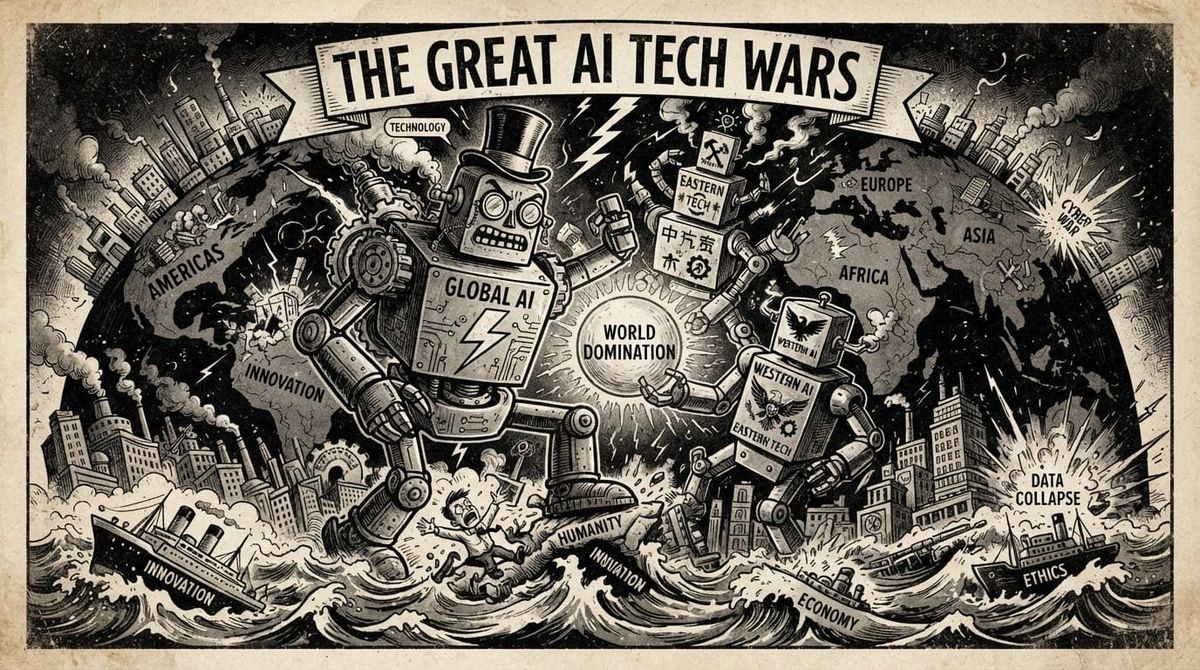
There is a meme I see every few days on LinkedIn. In the first panel it depicts a brilliant pink unicorn prancing through an enchanted forest with the caption “Day 1 in Cybersecurity.” In the second panel, a blackened and malnourished nag shuffles along an industrialized hellscape with the caption “Year 1 in Cybersecurity.” I came into this assignment feeling more like the pink unicorn, and I’m leaving it like the smog-blasted bag of bones, because AI has no defined borders. But countries do. This makes the international distribution and accountability of AI a steep and sprawling series of problems to solve. While this bibliography’s scope is broader than cybersecurity alone, the throughline is that all businesses, governments, and citizens already find themselves on a new battleground, wittingly or not. The globe has entered a high-stakes arms race. Everyone is after the most sophisticated AI with the cleanest shot at protecting themselves from infinite attackers. The country that possesses the technical know-how, the chips, and the power holds the key to winning it all. These sources collectively examine how the international distribution of technology creates structural breakdowns in cybersecurity and accountability across governments, businesses, and individual citizens.
Gerut, A. (2026, May 13). Encrypted texts reveal how Nvidia chips and U.S. tech are being smuggled to China and Russia. Fortune. https://fortune.com/2026/05/13/nvidia-chip-smuggling-china-russia-iran-export-controls-supermicro/
Nvidia chips are worth a bundle. For those with access to the semiconductors, it may prove tempting to sell them to China. The three men orchestrating the sales in the article are charged with conspiracy to violate the Export Control Reform Act. Their digital messaging back and forth may prove particularly damning within court records. The article notes the dizzying array of shell games criminals establish to sell microchips on the global black market. Frequently, other countries than the buyer act as middle-distributors to more highly sanctioned countries, specifically China and Russia. Notable in the article: the current Trump administration did not make any cuts with DOGE to the BIS, the Bureau of Industry and Security, as it maintains a sharp eye on exports. A more interesting legal question emerges towards the back half of the piece than its preceding caper: a Texas civil suit directed at Texas Instruments, Intel, and others tests whether or not the companies can be liable for their computer chips ending up in Russian weaponry and missiles.
Goldman, A., Bradley, J., Volz, D., & Schwirtz, M. (2026, June 26). A $2.5 billion whodunit: The hack that dented the U.K. economy. The New York Times. https://www.nytimes.com/2026/06/26/world/europe/jaguar-russia-hack.html
A mysterious group seized control of Jaguar’s network, with confusion coming into play when hacker groups within Britain attempted to claim credit for the attack, resulting in $2.5 billion in damages to the country’s economy. In actuality, it was a shadowy group of Russian hackers, with hints of protection from the Kremlin. One suggested motivation: take out one of Britain’s most powerful symbols and economic powerhouses in retaliation for Britain’s support of Ukraine. Jaguar’s response was to shut down its entire system, which impacted international supply chain and manufacturing, including in India.
Halpern, S. (2026, April 24). How big a threat are Iranian-backed cyberattacks? The New Yorker. https://www.newyorker.com/news/the-lede/how-big-a-threat-are-iranian-backed-cyberattacks
CISA reported that Iranian affiliated actors gained access to programmable logic controllers that run American-based infrastructure. The implication is that the move was retaliation for U.S.–Israeli strikes on Iran. The article goes into detail about the often lopsided tit-for-tat of the conflict. For example, Iran compromising Stryker's operations in retaliation for the bombing of an Iranian schoolhouse, killing more than 100 children. Notably, this is the second or third article I came across that’s underscored the U.S. reducing its CISA budget by $707 million at a moment that suggests boosting funds would be the smarter move. A hacking group, Seedworm, slithered into American firms that do business with Israel. The threat is that an unidentified and insidious presence can do damage at any moment.
Kang, C. (2026, June 12). Google says Chinese cybercrime group used its AI in scams. The New York Times. https://www.nytimes.com/2026/06/12/technology/google-lawsuit-china-ai-scams.html
I can’t be the only one receiving text messages warning me to pay my outstanding iPass tolls via the Illinois tollway. The only problem is that I haven’t driven on those roads in over nine years. Like the “E-ZPass” scams, nefarious Chinese groups are swindling Americans out of millions of dollars. Google identified the groups using its AI tool, Gemini, to mass-generate malicious clones of real websites with staggering scale. Partnership across borders is required to protect innocent people from AI-generated fraud.
McMillan, R. (2026, April 2). The college student—and his cat meme—who hunted the world's biggest cyberweapon. The Wall Street Journal. https://www.wsj.com/tech/kimwolf-hack-residential-proxy-networks-a712ab59
Raymond Chandler by way of a memeing college student. This piece is a cautionary tale of international proxy servers offering up millions of Android devices to the highest bidder, without the owners ever being the wiser. That a single persistent college student could untangle Kimwolf’s shadowy operation that exploited Ipidea’s proxy network stemming from China is a remarkable achievement. The most shocking revelation in the article is that hackers utilized corporations as a way to create an incredibly sophisticated backdoor into private American home networks.
McMillan, R., Huang, R., & Ramkumar, A. (2026, June 27). China has matched Anthropic in cybersecurity, resetting AI race. The Wall Street Journal. https://www.wsj.com/tech/ai/chinese-ai-anthropic-mythos-cybersecurity-574b02c2
The global fight for power and influence is in flux due to some Chinese AI models that are very different than the U.S. models. They’re open-weight, i.e., can be downloaded and altered by individuals autonomously. Without supervision, open-weight models offer incredibly powerful tools to potentially fall into the hands of bad actors. At the center of this concern is that the Chinese AI models are finding security bugs to match models in the U.S., even while still behind in other performance metrics. The U.S. government was criticized for ordering a halt on Anthropic’s latest models while simultaneously selling chips to China, which would in turn use those chips to continue building new and better models.
Neuberger, A. (2026, February 19). AI can help defend against cyberattacks. The Wall Street Journal. https://www.wsj.com/opinion/ai-can-help-defend-against-cyberattacks-909c9663
Anne Neuberger, former deputy national security adviser for cyber and emerging technology, describes the imbalance of the machine-speed arms race: humans do not have the speed of AI. It’s fundamentally easier to attack than it is to defend. Even more challenging: governments and systems are restricted by borders; attackers are not. She advocates for more data sharing, transparency, and best practices to help strengthen security. For example, vetting software sold to the government with AI. As the U.S. government is the largest purchaser of IT services, it would make sense to leverage its power to lead the way.
Rosen, B., & Kraprayoon, J. (2026, April 16). Cyberwar's new frontier: How AI agents will threaten global security. Foreign Affairs. https://www.foreignaffairs.com/united-states/cyberwars-new-frontier
Technology is wildly outpacing the governance and security needed to offer checks and balances to protect government, businesses, and citizens. Currently, it is often the tech companies, in this case, Anthropic, raising red flags, not government agencies. The article implies the attack may not have been noticed at all by federal authorities, had Anthropic not spoken up. Anthropic’s alarm specified a Chinese-backed group of hackers using the Claude system to attack some 30 organizations, including government. The article outlines a steep set of actions and suggestions to allow a global network to protect itself from autonomous agents.
Witt, S. (2025, October 27). Inside the data centers that train AI and drain the electrical grid. The New Yorker. https://www.newyorker.com/magazine/2025/11/03/inside-the-data-centers-that-train-ai-and-drain-the-electrical-grid
Data centers are a hot topic. No pun intended. The electricity consumption therein is staggering: large data warehouses consume about the same amount of electricity as the city of Philadelphia, 1 gigawatt. The power supply available, at least in the U.S., may not be able to keep up. The article observes that China, in its own pursuit of electrical power to feed these data centers, is building 26 nuclear reactors. The article implies this is not likely to be matched in the U.S., at least with the same speed. As much as the pursuit of “winning” the AI race captures the world’s attention, it is the arms race of the muscle backing it that might provide hints as to the outcome.
Zetter, K. (2025, July 18). How China's patriotic "Honkers" became the nation's elite cyberspies. Wired. https://www.wired.com/story/china-honkers-elite-cyber-spies/
Honkers, a group of patriotic Chinese hackers, were initially celebrated for their targeted attacks on other countries, corporations, and organizations that had “disrespected” their homeland. However, as international skirmishes escalated, so too did the Honkers. The group mutated into various hacking personalities. What’s most telling is that these individuals became the scaffolding for China’s spy network.